

How To Calculate Margin In Forex
Margin Calculation for Retail Forex, Futures
The trading platform provides different take chances management models, which ascertain the type of pre-merchandise control. The post-obit models are currently bachelor:
- For Retail Forex, Futures — used for the OTC market. Margin calculation is based on the type of instrument.
- For Stock Exchange, based on margin discount rates — used for the exchange market. Margin calculation is based on the discounts for instruments. Discounts are gear up by the broker, however they cannot be lower than the substitution set values.
The margin is charged for securing traders' open positions and orders.
The first stage of the margin calculation is defining if an account has positions or awaiting orders for the symbol, for which a trade is performed.
- If the account has no positions and orders for the symbol, the margin is calculated using the formulas below.
- If the account has an open position, and an order of whatever type with the volume existence less or equal to the current position is placed in the opposite direction, the total margin is equal to the electric current position's one. Example: nosotros take a one lot EURUSD Buy position and place an order to Sell one lot EURUSD (similarly for Sell Limit, Sell Cease and Sell Cease Limit).
- If the account has an open position, and an order of any blazon is placed in the same direction, the full margin is equal to the sum of the current position's and placed order's margins.
- If the business relationship has an open position, and an order of any type with the volume exceeding the current position is placed in the opposite direction, two margin values are calculated - for the electric current position and for the placed gild. The last margin is taken co-ordinate to the highest of the two calculated values.
- If the account has two or more oppositely directed market and limit orders, the margin is calculated for each direction (Buy and Sell). The terminal margin is taken co-ordinate to the highest of the ii calculated values. For all other order types (Terminate and Finish Limit), the margin is summed up (charged for each lodge).
Below are the symbol margin calculation formulas according to their type and settings. The final margin is calculated in three stages:
- Bones calculation for a certain symbol;
- Conversion of the margin currency into the deposit one
- Multiplication by factor
- Because trading symbols that are in spread
- Accounting multiple positions/orders of the same symbol
Basic Calculation for a Symbol #
If "Initial margin" parameter value is ready in the symbol specification, this value is used. The formulas described in this section are not practical.
The trading platform provides several margin requirement calculation types depending on the financial instrument. Calculation type is displayed in the "Calculation" field of the symbol specification:
Forex
The margin for the Forex instruments is calculated past the following formula:
Volume in lots * Contract size / Leverage
For example, let's calculate the margin requirements for buying 1 lot of EURUSD, while the size of one contract is 100,000 and the leverage is ane:100.
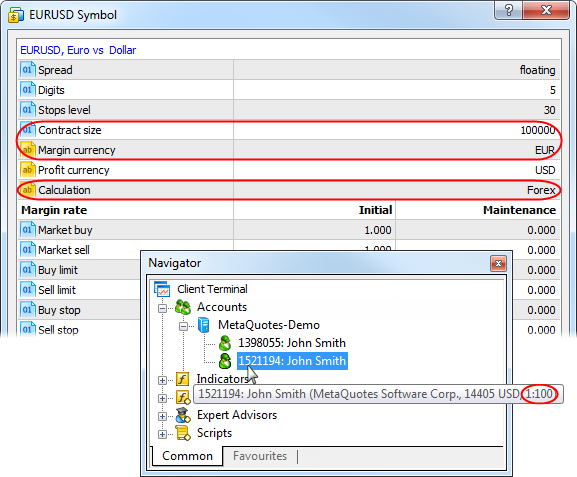
After placing the advisable values to the equation, we will obtain the following consequence:
i * 100 000 / 100 = i 000 EUR
So, at present nosotros have the margin requirements value in base currency (or margin currency) of the symbol.
- More often than not, margin requirements currency and symbol's base currency are the aforementioned. If the margin currency is different, adding results are displayed in that currency instead of the symbol'south base one.
- In this mode, a trader leverage is taken into account even if a stock-still margin is set.
Forex No Leverage #
This type of calculation is besides used for Forex symbols. Simply different the previous ane, it does non take into account the trader's leverage:
Volume in lots * Contract size
For case, let's calculate the margin requirements for buying ane lot of EURUSD, while the size of one contract is 100 000 and the leverage is one:100. Afterwards placing the advisable values to the equation, we will obtain the following result:
1 * 100000 = 100000 EUR
So, now nosotros have the margin requirements value in base currency (or margin currency) of the symbol.
Mostly, margin requirements currency and symbol's base currency are the aforementioned. If the margin currency is different, calculation results are displayed in that currency instead of the symbol'south base of operations one.
Contracts, Exchange Stocks
The margin requirements for contracts and stocks are calculated using the following equation:
Book in lots * Contract size * Open market price
The electric current marketplace Ask price is used for purchase deals, while the current Bid price is used for sell ones.
For example, let'southward calculate the margin requirements for buying one lot of #AA, the size of the contract is 100 units, the current Ask cost is 33.00 USD.
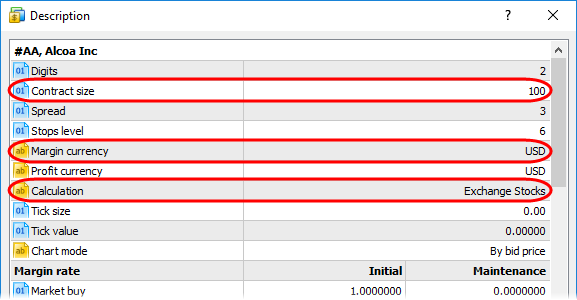
Afterwards placing the appropriate values to the equation, we volition obtain the following result:
one * 100 * 33.00 = 3300 USD
And so, now we have the margin value in base currency (or margin currency) of the symbol.
Contracts Leverage
The leverage is likewise considered in this type of margin requirement adding for contracts:
Volume in lots * Contract size * Open market place price / Leverage
Contracts Index #
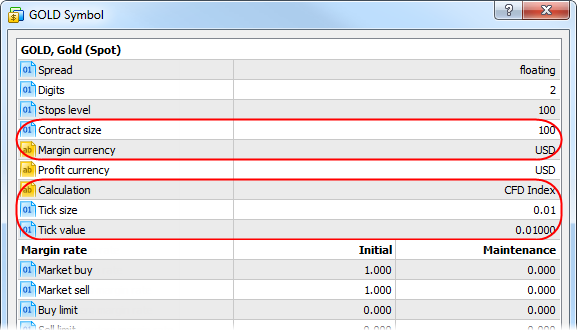
For index contracts, the margin requirements are calculated according to the post-obit equation:
Volume in lots * Contract size * Open market price * Tick price / Tick size
In this formula, the ratio of cost and tick size is considered in add-on to common contracts adding.
Futures, Exchange Futures #
There are 2 types of the margin requirements for futures contracts:
- Initial margin is the corporeality that must be bachelor on the business relationship at the moment of attempting to enter the market. Further maintenance of the aforementioned sum may not be obligatory.
- Maintenance margin is the minimum amount that must be available on the account for maintaining an open position.
Both values are specified in the symbol specification.
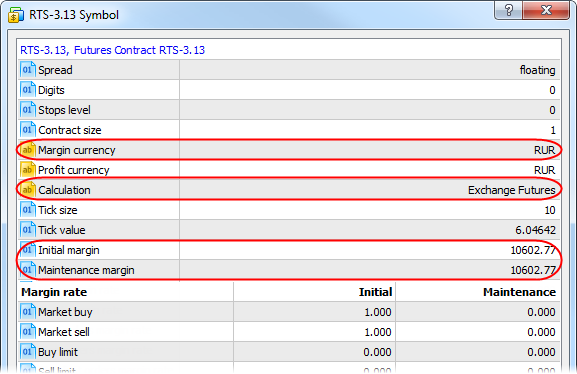
The final size of the margin depends on the book:
Volume in lots * Initial margin
Book in lots * Maintenance margin
If the corporeality of the maintenance margin is not specified, the initial margin value is used instead.
Commutation Options #
There are two types of margin requirements for futures contracts:
- Initial margin is the amount that must exist available on the account at the moment of attempting to enter the market. Further maintenance of the same amount may not exist obligatory.
- Maintenance margin is the minimum corporeality that must exist available on the account for belongings a position open.
Both values are specified in the symbol specification. The final size of the margin depends on the book:
Volume in lots * Initial margin
Volume in lots * Maintenance margin
If the corporeality of the maintenance margin is non specified, the initial margin value will be used instead. If neither the initial nor the maintenance margin is specified, the appropriate value volition be calculated co-ordinate to the following formula:
Volume in lots * Contract size * Open market place price
The current marketplace Inquire price is used for buy deals, while the electric current Bid price is used for sell deals.
The aforementioned adding method is practical for all adventure direction modes.
Commutation Bonds #
The bond margin is calculated equally role of the position value. Bail prices are provided equally a face value percentage, so the position value is calculated every bit follows:
Volume in lots * Contract size * Face value * Price / 100
The part of the position value to exist reserved for maintenance is determined by margin ratios.
FORTS Futures
The margin for the futures contracts of the Moscow Commutation derivative section is calculated separately for each symbol: First, the margin is calculated for the open position and all Buy orders. Then the margin for the same position and all Sell orders is calculated.
MarginBuy = MarginPos + Sum(MarginBuyOrder)
MarginSell = MarginPos + Sum(MarginSellOrder))
The largest one of the calculated values is used as the final margin value for the symbol.
Thus, the same position is used in the adding of both values. In the first formula (which includes Purchase orders), the position margin is calculated equally follows:
MarginPos = Book * (InitialMarginBuy + (Open Price - SettlementPrice) * Tick Price / Tick Size * (1 + 0.01 * Margin Currency Rate))
The volume is used with a positive sign for long positions and with a negative sign for brusk positions.
In the second formula (which includes Sell orders), the position margin is calculated as follows:
MarginPos = Book * (InitialMarginSell + (SettlementPrice - Open Price) * Tick Price / Tick Size * (ane + 0.01 * Margin Currency Rate))
The volume is used with a positive sign for brusk positions and with a negative sign for long positions.
This approach provides the trader a discount on margin, when in that location is an open position in the opposite management with respect to the orders placed (the position acts as collateral for orders).
Margin on orders is calculated past the following formulas:
MarginBuyOrder = Volume * (InitialMarginBuy + (Price - SettlementPrice) * Tick price / Tick size * (ane + 0.01 * Margin currency charge per unit))
MarginSellOrder = Book * (InitialMarginSell + (SettlementPrice - Cost) * Tick price / Tick size * (ane + 0.01 * Margin currency charge per unit))
'Cost' here depends on the guild time and can be equal to:
- The Highest and the Lowest toll of the contract for the current session is used for not however executed marketplace or stop Buy and Sell orders, respectively. Since the toll is not specified in market orders, the trader is charged the maximum possible margin. Once triggered, finish orders behave similar to market orders .
- The order price is used for limit orders.
- The Cease Limit price is used for end limit orders.
Other parameters in the formulas:
- InitialMarginBuy — the initial margin for the Buy functioning.
- InitialMarginSell — the initial margin for the Sell operation.
- Currency margin charge per unit is the rate modify radius of the currency, a futures contract is denominated in, relative to the Russian ruble
- SettlementPrice — settlement price of an musical instrument for the current session.
All these parameters for adding are provided by the Moscow Commutation.
InitialMarginBuy is written to the "Initial margin" field, InitialMarginSell is written to the "Maintenance Margin" field in symbol properties.
Adding instance
The below example shows the calculation of margin requirements for the following trading account country:
- Position Buy 3.00 Si-6.18 at 73640
- Order Buy Limit 2.00 Si-6.18 at 73000
- Order Sell Limit 10.00 Si-six.eighteen at 74500
Current session parameters
- Clearing price = 73638
- InitialMarginBuy = 7665.41
- InitialMarginSell = 7739.59
- Tick toll = i
- Tick size = 1
- Margin currency rate = 0
Nosotros substitute the values in the formulas
MarginBuy = 3 * (7665.41 + (73640 - 73638) * 1/1) + 2 * (7665.41 + (73000-73638) * i/1) = 37057.05
MarginSell = -3 * (7739.59 + (73638-73640) * 1/1) +10.0 * (7739.59 + (73638-74500) * 1/one) = 45563.xiii
Margin = Max(37057.05, 45563.13) = 45563.13
The resulting margin for the Si-six.18 symbol is 45563.thirteen.
Collateral #
Non-tradable instruments of this blazon are used equally trader'due south avails to provide the required margin for open positions of other instruments. For these instruments the margin is non calculated.
Fixed Margin #
If the "Initial margin" field of the symbol specification contains any non-zero value, the margin calculation formulas specified in a higher place are non applied (except for the adding of futures, equally everything remains the aforementioned in that location). In this case, for all types of calculations (except for Forex and Contracts Leverage), the margin is calculated like for the "Futures" calculation type:
Volume in lots * Initial margin
Volume in lots * Maintenance margin
Calculations of the Forex and Contracts Leverage types additionally allow for leverage:
Volume in lots * Initial margin / Leverage
Volume in lots * Maintenance margin / Leverage
If the amount of the maintenance margin is non specified, the initial margin value is used instead.
Converting into Deposit Currency #
This stage is mutual for all calculation types. Conversion of the margin requirements calculated using one of the to a higher place-mentioned methods is performed in case their currency is different from the business relationship deposit one.
The electric current commutation charge per unit of a margin currency to a deposit one is used for conversion. The Ask toll is used for buy deals, and the Bid price is used for sell deals.
For example, the basic size of the margin previously calculated for buying one lot of EURUSD is 1000 EUR. If the account deposit currency is USD, the current Ask toll of EURUSD pair is used for conversion. For example, if the current charge per unit is i.2790, the total margin size is 1279 USD.
Margin Rate #
The symbol specification allows setting additional multipliers (rates) for the margin requirements depending on the position/order type.
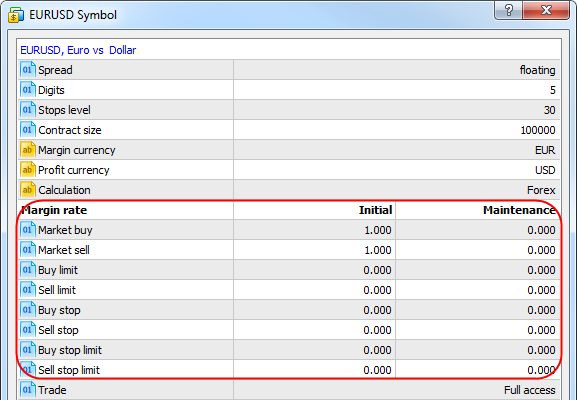
The final margin requirements value calculated taking into account the conversion into the eolith currency, is additionally multiplied past the appropriate rate.
For example, the previously calculated margin for ownership one lot of EURUSD is 1279 USD. This sum is additionally multiplied past the long margin rate. For example, if it is equal to one.15, the terminal margin is 1279 * 1.xv = 1470.85 USD.
Calculations for Spread Trading #
The margin can be charged on preferential basis in case trading positions are in spread relative to each other. The spread trading is defined equally the presence of the oppositely directed positions of correlated symbols. Reduced margin requirements provide more trading opportunities for traders. Configuration of spreads is described in a split up section.
Spreads are merely used in the netting arrangement for position accounting.
Calculation in the hedging system of position accounting #
If the hedging position bookkeeping system is used, the margin is calculated using the same formulas and principles as described above. However, there are some boosted features for multiple positions of the same symbol.
Positions/orders open in the same direction
Their volumes are summed up and the weighted boilerplate open price is calculated for them. The resulting values are used for calculating margin by the formula corresponding to the symbol blazon.
For pending orders (if the margin ratio is non-zip) margin is calculated separately.
Opposite Positions/Orders
Oppositely directed open up positions of the same symbol are considered hedged or covered. Ii margin calculation methods are possible for such positions. The calculation method is determined past the banker.
| Basic adding | Using the larger leg |
|---|---|
| Used if "calculate using larger leg" is not specified in the "Hedged margin" field of contract specification. The adding consists of several steps:
The resulting margin value is calculated as the sum of margins calculated at each step. Adding for uncovered book
Adding for covered book Used if the "Hedged margin" value is specified in a contract specification. In this case margin is charged for hedged, besides as uncovered volume. If the initial margin is specified for a symbol, the hedged margin is specified as an absolute value (in monetary terms). If the initial margin is non specified (equal to 0), the contract size is specified in the "Hedged" field. The margin is calculated past the advisable formula in accordance with the blazon of the fiscal instrument, using the specified contract size. For example, we have ii positions Buy EURUSD 1 lot and Sell EURUSD one lot, the contract size is 100,000. If the value of 100,000 is specified in the "Hedged field", the margin for the ii positions will be calculated every bit per 1 lot. If you specify 0, no margin is charged for the hedged (covered) volume. Per each hedged lot of a position, the margin is charged in accordance with the value specified in the "Hedged Margin" field in the contract specification:
Calculation for pending orders
Adding specifics for hedging orders when using fixed margin When an society opposite to an existing position is placed, the margin on the hedged book is e'er calculated using the "Hedge margin" value. For the not-hedged volume, the "Initial margin" value is used when placing an order, and "Maintenance margin" is practical after the advisable position is opened. These adding specifics just utilize for symbols, for which the initial and maintenance margin values are specified (adding blazon "Fixed margin" or "Futures"). For case, the following parameters are used for EURUSD:
A trader has a position Buy one.00 BR-12.18 on a USD business relationship. A margin of 500 USD (as per the "Maintenance margin") is reserved on the trader'due south account for this position.
| Used if "calculate using larger leg" is specified in the "Hedged margin" field of contract specification.
|
| Instance The following positions are present:
Hedged margin size = 100 000. Buy margin rate = two, for Sell = 4. Calculate hedged volume: Sell volume (3) - Buy book (2) = i Calculate the weighted average Open price for the hedged volume by all positions: (one.11943 * 1+1.11953 * 1+1.11943 * 1+one.11953 * 1+i.11943 * one)/5 = 5.59735/5= 1.11947 Calculate the weighted average Open up toll for the non-hedged volume past all positions: (1.11943 * one + 1.11943 * ane + 1.11943 * one)/three = ane.11943 Summate the margin ratio for the hedged volume: (buy ratio + sell ratio)/2 = (ii + 4)/2 = three The larger leg (sell) margin ratio is used for the not-hedged volume: four. Calculate the hedged volume margin using the equation: (two.00 lots * 100000 EUR * 1.11947 * three) / 500 = 1343.36 Calculate the non-hedged volume margin using the equation: (1.00 lot * 100000 EUR * one.11943 * 4) / 500 = 895.54 The final margin size: 1343.364 + 895.544 = 2238.ninety |

How To Calculate Margin In Forex,
Source: https://www.metatrader5.com/en/terminal/help/trading_advanced/margin_forex
Posted by: sabinsobsed.blogspot.com
0 Response to "How To Calculate Margin In Forex"
Post a Comment